Most clubs list ten things they want to be good at. It reads well on a website and it means nothing on a Tuesday night in November.
This season Talata is betting on two: we guard you closely enough to be uncomfortable, and we take every rebound. That's it. Here's the thinking, because we'd rather parents and players understand the plan than just be told it.
Why two and not ten
A club our size can't out-talent everybody in Copenhagen. What we can do is be the hardest team in the hall to score on and the team that keeps the ball. Both are effort skills. Both are trainable at every age from U9 to Men. Neither requires us to be the tallest or the most naturally gifted group in the league.
They're also, really, the same skill twice. Tight pressure produces rushed, contested shots. Rushed, contested shots miss long, and they miss predictably. If you know where the ball is going to land, you own the possession.
The defence: close, and toward the line
Two ideas do most of the work.
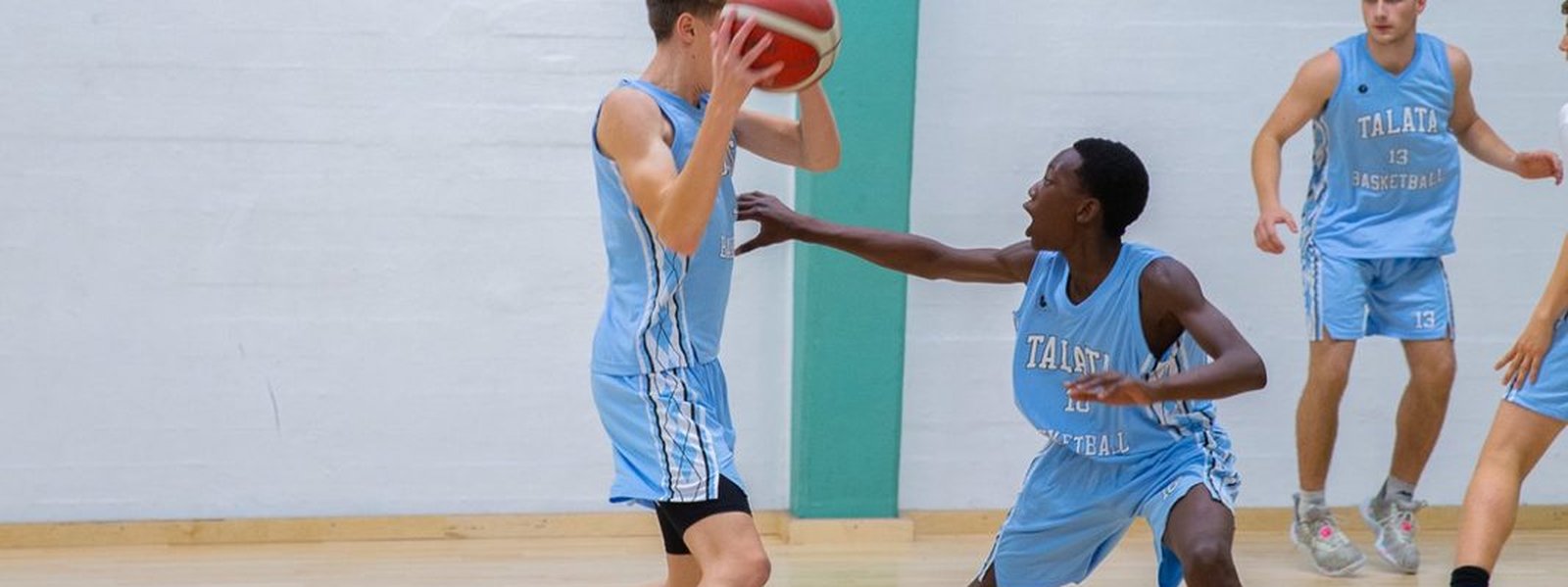
Guard closer than feels sensible. Distance is comfort, so we remove it. The cost is that you get beaten sometimes, and we accept that trade. We'd rather live with a blow-by we can help on than give up a clean, in-rhythm three.
Use the sideline as a sixth defender. We angle our body so the easy path is toward the line rather than back to the middle. The middle is where an offence breathes and finds the extra pass. Two defenders and a line beat three defenders and an open middle.
We're careful about how we teach this. “Force them to the line” is a positioning instruction, not permission to make contact, and our coaches say the full phrase to younger players rather than the shorthand.
Underneath it we use a framework from Chris Oliver at Basketball Immersion: every player answers two questions every possession. Who is my check? and What is my responsibility? They aren't the same question, and the gap between them is where most youth defences break.
The rebounding: three rules
Our rebounding rules are adapted from Brad Underwood at Illinois, who rebuilt his by charting where missed shots actually land instead of where tradition says they land.
One. Above the top of the key, you're back. Position, not squad number. The old rule of sending the point guard back broke the moment teams started setting ball screens, because the point guard ends up under the rim and the big men pop out.
Two. If you shoot a three, you're back. You knew it was going up first and you're furthest from the rim. The other four crash.
Three. From the corner, never run the baseline. Run the middle. The baseline route arrives late, under the rim, into traffic, where the ball usually isn't.
The part almost nobody teaches
We teach perimeter players to block out.
That sounds small. It's the whole thing. In most youth programmes, guards and wings are told to leak out, or simply never coached on rebounding at all, so they grow up as non-rebounders and it is never fixed. Ours will be rebounders. If you come to a Talata session on any day of the week, you should be able to tell inside twenty minutes that this is a rebounding team.
Rules first, decisions later
A rigid rule and a thinking player aren't opposites, they're the same lesson at different ages. Our U9s and U11s get one simple rule and run it automatically. By U17 and Men, players earn the right to read the situation and decide for themselves whether to crash.
One honest caveat we put in writing for our own coaches: the Illinois rules come from charting their misses, with a team taking roughly half its shots from three. We haven't charted ours yet. So we start with these as defaults, chart our own misses all season, and change the rules to match what we actually see. The lesson is the charting, not the numbers.
How you will know if it worked
Our guards and wings show up in the rebounding numbers, not just our big men. We give up fewer clean, in-rhythm threes than last season. And by spring, our rules match our own chart rather than somebody else’s.
Ask your kid what the rebounding rules are. If they can't tell you, we haven't done our job yet.
See how we coach
The Talata Way is how we run every session, at every age. First session is always free.
Book a free session